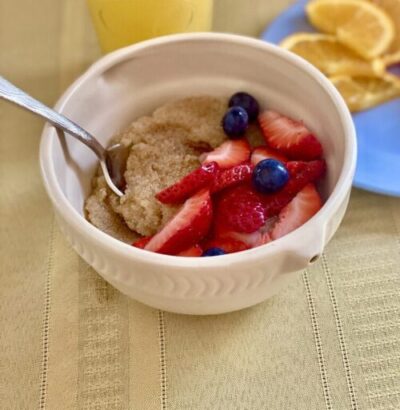

On a recent retreat, I rediscovered an amazing and tasty food – amaranth. This ancient grain has flown under the radar in modern day, but it should be in the limelight because of its nutritive value alone, not to mention its flavor and versatility. The amount of nutrition packed into this tiny grain is truly incredible! It is definitely a case of good things in small packages. And did I mention – it’s gluten free!
I had a package of amaranth in my pantry that I had been using to grind into a gluten free flour for several of my recipes. But for whatever reason, I never thought about using it as a base for veggie bowls or as a side dish all on its own. One night at the retreat, there it was; a large bowl of cooked amaranth on the buffet. One taste and I was hooked. It was so good! Hats off to Eytan Kurland, the chef at the Dharmakaya Center for Wellbeing! He put together amazing vegan, gluten free spreads daily! On my first night home after the retreat, I grabbed that package of amaranth from my pantry and prepared it for my family as a base for some delicious roasted veggies and a Dharmakaya inspired avocado-lime sauce. It was so good! And now, amaranth is going to be elevated in the Owen house from simply a gluten free flour to a staple for porridges and bases for meals.
So what is amaranth?
Amaranth is a tiny grain about the size of sand. Botanically, it is not classified as a cereal grain, instead it is considered a pseudo cereal. Cereal grains are the seeds of grasses like barley, wheat, and rice, while pseudo cereals are the seeds of grass-like plants such as quinoa and buckwheat. Amaranth is an ancient grain that has been cultivated for more than 8000 years. It was widely used by the pre-Columbian civilizations of the Aztecs, Mayans, and Incans. With Spanish colonization and the prevalence of crops such as wheat and barley, amaranth fell out of use and became a niche crop. But now amaranth is experiencing a resurgence and beginning to gain a foothold as a supergrain.
What makes tiny amaranth so mighty?
Protein
The nutrition in this grain is amazing. The ancient Aztec, Mayan, an Incan civilizations knew what they were doing when they used it as a staple. At 18%, amaranth has a very high protein content compared to other grains which are typically in the 8-14% range. In addition, amaranth is one of a few grains that contain all 9 essential amino acids, making it an excellent choice for vegans or anyone on a plant-based diet. It is also particularly high in the amino acids lysine and tryptophan which are vital for wound healing, neurotransmitter production, collagen production, and anxiety reduction among other things.
Fiber
Recent nutritional literature highlights the importance of dietary fiber for health. Amaranth is a high fiber food with 18 grams of fiber in a one-cup serving. It contains both soluble and insoluble fiber so it not only feeds the gut microbes, but it also helps digested food move through the digestive tract improving elimination.The SAD (standard American diet) is pitifully low in fiber, typically approximately 10-14 grams per day, which is one of many reasons it creates such poor health. The current recommended daily fiber intake in the US is 25 grams, but this is likely much too low for optimal health. Incorporating amaranth into the diet can greatly improve fiber status.
Fats
Amaranth also contains a healthy dose of both unsaturated and saturated fats. This includes some very healthy omega 3 (predominantly alpha-linoleic acid) and omega 6 (predominantly linoleic acid) essential fatty acids. Essential fatty acids (EFAs) are those that the body cannot synthesize and must be obtained from food. Amaranth also contains omega 9 fatty acids and saturated fatty acids such as oleic acid and palmitic acid, respectively. In addition, amaranth is a good source of squalene, an important fat that is a precursor to cholesterol, an antioxidant, an anti-inflammatory, and involved in numerous functions in the body. Amaranth’s broad lipid (fat) profile makes it a good source of unsaturated fatty acids and LDL cholesterol lowering, antioxidant, and cancer preventing compounds.
Vitamins
On top of all that, amaranth provides a range of B vitamins, vitamin C, and vitamin E. It is an excellent source of vitamins B1 (thiamine), B2 (riboflavin), B3 (niacin), B6 (pyridoxine), and B9 (folate). B vitamins are crucial for a multitude of processes in the body including energy metabolism. Amaranth contains a good amount of vitamin C which is a strong antioxidant that prevents free radicals from damaging tissues. It is also a good source of vitamin E which is another excellent antioxidant and a skin hero with its ability to boost collagen production and improve skin elasticity and resilience.
And there’s more…
Minerals
Amaranth contains a host of health promoting minerals. This includes high amounts of calcium, iron, magnesium, manganese, phosphorus, and potassium and lower amounts of other minerals such as zinc. The broad mineral profile provides benefits to bone health, red blood cell production, DNA synthesis, heart health, brain health, and muscle health. In fact, one serving of amaranth provides more than the daily requirement for manganese, a neuroprotective mineral that helps healthy brain function. This nutritionally dense grain is a better source of iron than wheat, spinach, and even meat. Studies showed that feeding amaranth rich bread to children in underprivileged countries increased iron status and reduced anemia.
Heath benefits
The seed of the amaranth plant is the most commonly used part of the plant, but the leaves and oil are also used. Amaranth oil is a stable oil that resists oxidation and has been shown to have significant health benefits. Not only does it possess high antioxidant properties, but It also helps manage blood glucose levels, lower blood pressure, and regulate blood lipids including cholesterol.
This supergrain’s list of health benefits include:
- Reduces inflammation
- Protects DNA damage
- Fends off infection
- Protects the liver
- Protects the heart
- Protects the brain and nervous system
- Reduces cholesterol
- Promotes weight loss
- Protects the body from cancer
- Prevents anemia
To date, 25 different polyphenols have been identified in amaranth. These and a few other constituents are responsible for its strong antioxidant properties. Antioxidants protect the body from free radical damage that can alter DNA and potentially cause cancer.
So how do you use this super grain?


There are several ways to use amaranth. It is commonly finely ground and used as a flour in breads, cookies, and other treats. This was my go-to use for amaranth until my eyes and tastebuds were open! Amaranth grains can be cooked in water similar to quinoa or other grains and used as a base for veggie bowls, stir frys, roasted vegetables, etc. In this way it can be a filling gluten free, high protein addition to a meal. Its mild, slightly sweet taste makes amaranth a great porridge choice. Simply cook it in abundant water until the desired consistency and add some spices, fresh or dried fruit, nuts, nut butter, maple syrup, honey, or whatever your heart desires. It makes an excellent nutritious breakfast and a great alternative to oatmeal. For a tasty snack amaranth can also be popped like corn. Simply heat a skillet and add spoonfuls of dry amaranth grains until they pop creating miniature versions of popcorn.
In a nutshell…
Amaranth is my new obsession. It is a nutritionally dense grain that tastes great while protecting the body from a range of health issues including some of the most significant issues plaguing our culture – heart disease and metabolic issues. It is easy to prepare, taking just 20 minutes to create a base for meals or a delicious breakfast porridge. It can also be used as a nutritionally dense gluten free flour. I hope you will give this mighty supergrain a try so you can enjoy the taste while knowing you are doing a world of good for your body. I’ll be posting recipes soon with amaranth as the star. Let me know if you try it and what you think. Let’s help this little grain regain its place in the limelight.
4 responses to “Amaranth – tiny but mighty”
I will certainly try it. I think I have had a cereal that included it. Love ancient grains!
That’s great Lynn. Let me know what you think.
Glad you enjoyed the food at the retreat! I will try it
It was a beautiful facility. Thinking about the Costa Rica retreat!!