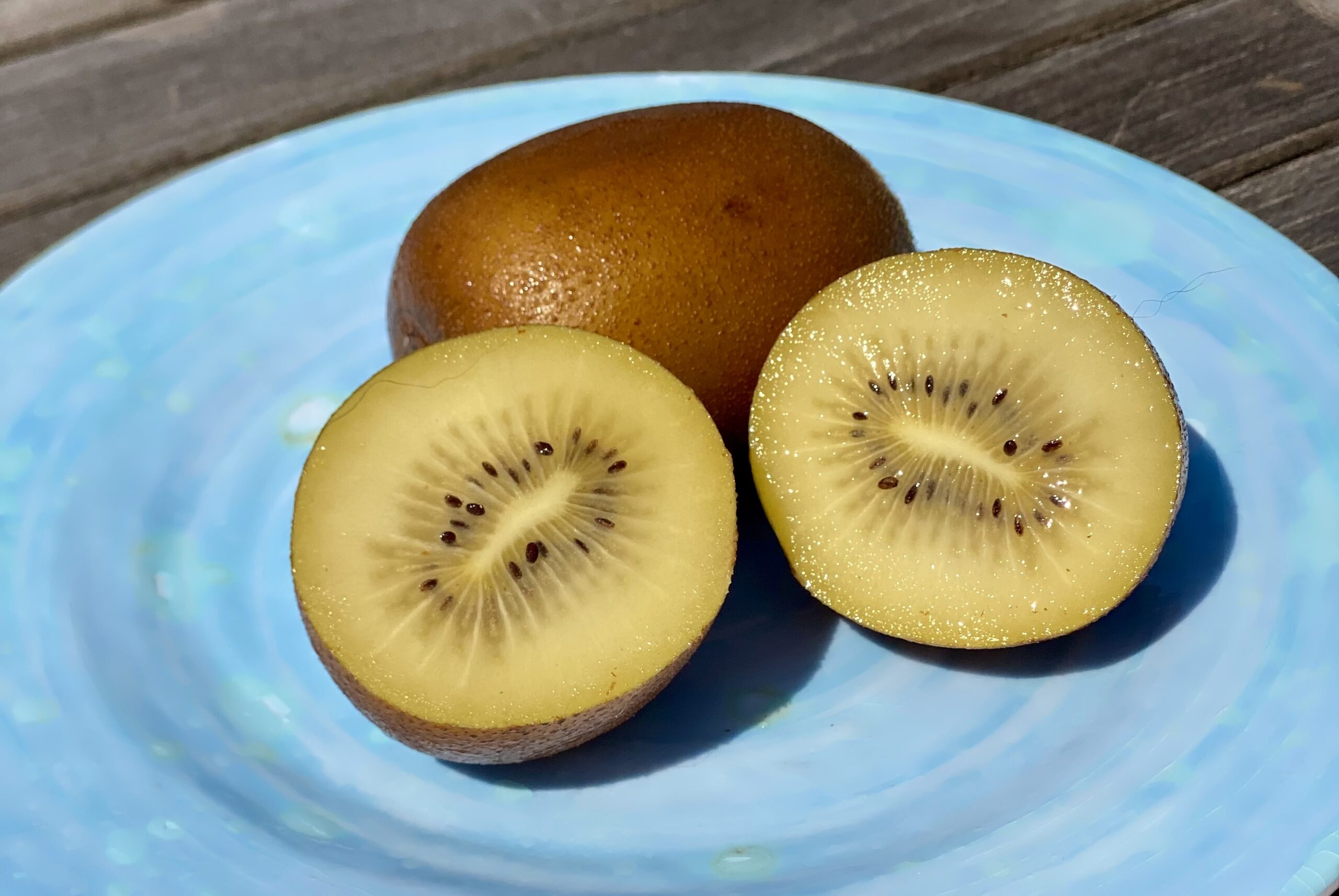
A whole lot of nutrition is packed into this unassuming little brown dynamo!
The kiwi is a small oblong fruit that is light brown on the outside with skin ranging from fuzzier than a peach to slightly rough in texture. Inside this thin skin is a golden to bright green, sweet, juicy flesh with a central cluster of small black seeds.

All this time, I thought kiwi fruit, aka, kiwi was native to New Zealand. It’s what I was told and what I taught my children. But now I stand corrected. These tasty green gems were being eaten long before they made their Oceania appearance.
A bit of kiwi history…
We have to go back to the Tang dynasty (618-907 AD) to find the first mention of kiwis which grew wild in the Yangtse Valley of China. The fruit we now know of as kiwis was then called yang tao (strawberry peach) for its taste or mihoutao (monkey peach) for its primate connoisseurs. The Chinese used kiwi as a digestive aid and medicine for digestive disorders. Scottish missionaries venturing to China discovered this wonder fruit and brought it to the attention of Europe in the mid 1700s. However, it wasn’t until 150 years later that the kiwi finally made its way to New Zealand.
In 1904, a New Zealand school teacher, Mary Isabel Frazer, returned from a trip to China with kiwi seeds in tow. Enjoying the New Zealand conditions, the plant was eventually cultivated and sold as a fruiting climber called Chinese Gooseberry. In 1922, Hayward Wight, an Auckland grower, developed a cultivar, the Hayward, which is the variety we commonly know now.
The need for exporting became evident after US soldiers stationed in NZ during WWII fell in love with these fuzzy green fruits. Some savvy exporters realized that a name change was in order to dissociate from anticommunist sentiment, so the Chinese Gooseberry was renamed for New Zealand’s national bird, the kiwi. And voila, the kiwi fruit was born.
(Pop a long beak on a kiwi fruit and it really looks quite similar to its namesake!)
Kiwi Health Benefits
So why am I expounding on this little fruit? Because kiwis are nutritional powerhouses that, although known by the ancients as a medicinal food, have only recently come into the limelight for their health benefits. In addition to becoming a New Zealand crop, kiwi fruit has also been cultivated in Italy where this fuzzy fruit is known as frutto della salute or fruit of health owing to its high vitamin C content. But vitamin C is not the only health attribute of kiwi.
The Hayward cultivar with its pale brown fuzzy skin enclosing vivid green flesh is an excellent source of soluble and insoluble fiber especially if you eat the skin. It’s a little fuzzier than a peach, but still quite edible. The Hayward kiwi comes in third for fruit with the highest vitamin C content putting oranges, that quintessential vitamin C rich fruit, to shame.
Another cultivar, the SunGold kiwi has a smoother skin and paler, almost golden flesh. The fiber content is lower than the Hayward variety, but the vitamin C content is almost double, making the SunGold an outstanding source of this antioxidant vitamin.

Good digestion is critical to good health.
Turns out kiwis are digestion rockstars! Their high fiber and water content helps to form soft stools that move easily along the intestines for prompt elimination. The fiber and other compounds in kiwis increase water retention in the intestines which softens stool and improves gut motility, the movement of stool through the intestines. Plus, kiwis have been shown to reduce gut transit time, the time it takes from eating food to having a bowel movement. When transit time is slow, waste sits in the intestines causing discomfort, bloating, and the potential for toxins to be reabsorbed instead of eliminated.
What’s more is that all this fiber serves as a treat for your gut microbiome. The beneficial microbes in your gut ferment fiber and create important compounds called short chain fatty acids (SCFAs). SCFAs serve diverse functions in the body including helping maintain the integrity of your intestinal lining, interacting with the immune cells that sit along that lining, and communicating with the brain via the gut-brain axis. Check out my Fiber – The Gut’s BFF post for more information on fiber’s role in our health. In addition to the fiber, kiwis contain an enzyme called actinidin that breaks down proteins and aids in the digestion of protein rich foods further helping digestion and nutrient absorption.

The cases of digestive disorders have dramatically risen in the last several decades. It is estimated that nearly 20% of the US population suffers from some level of constipation. This is likely due to the preponderance of processed food and insufficient fiber and water intake. It is especially common in older adults. Eating two kiwi fruits daily improves digestion, relieves constipation, improves the gut transit time, and reduces digestive discomfort. Even people with IBS have experienced digestive benefits from eating kiwis.
Even More Health Benefits
Beyond digestion, kiwis promote healthy weight and blood sugar control. For a fruit that is quite sweet and high in natural sugars especially in the SunGold variety, kiwi’s glycemic index (GI) is low. The GI of a food is an indicator of how it affects blood sugar spikes. This means that kiwis allow you the pleasure of sweetness without wreaking havoc on your blood sugar. In addition, kiwis have been shown to improve blood lipids and increase the HDL to LDL ratio. Furthermore, some studies show they may improve blood pressure. Good blood sugar and blood pressure control are hallmarks of health.
The nutritional profile for kiwis includes vitamin B9 (folate), vitamin C, vitamin E, and potassium, as well as an array of bioactive compounds. The vitamins C and E, plus several of kiwi’s bioactive compounds are antioxidants including beta carotene, lutein, zeaxanthin, phenolics, and chlorophyll. Although the total antioxidant content of kiwi is lower than berries and oranges, human studies suggest that eating kiwis appears to decrease oxidative stress, inflammation, and the risk of cardiovascular disease. These benefits are attributed to kiwi’s antioxidants, but are likely related to the other compounds present in the whole fruit matrix. Another shout out to the benefits of whole foods!

Four Ways to Eat a Kiwi
So how do you actually eat a kiwi? Maybe because it is brown and fuzzy, at first a kiwi might seem a bit off-putting, but once you savor that sweet, slightly tart, juicy flesh, your inhibitions will evaporate. Here are a few different methods you can employ to eat this sweet treat.
- Eat it like a peach. Bite into it, eating it whole, just avoiding the hard little vestige of the stem. The juice may run down your face, but that’s a small price to pay for the convenience.
- When I was traveling in New Zealand, I was enlightened to a new way of eating kiwi; with a spoon! Cut a small slice off the stem end or use the tip of your spoon to pop out the stem, then use a spoon to scoop the juicy flesh out of the skin, much as you would a soft boiled egg. This is good for those texture conscious eaters who cannot tolerate the fuzziness. My kids loved when they would find a kiwi and a spoon in their school lunches instead of the customary apple.
- Core the stem end, and slice up the kiwi into ¼ inch slices. These rounds with the ring of black seeds around the center make an attractive way to serve kiwis on a fruit platter. You can either remove the skin or keep it on.
- Pop a kiwi into a smoothie. It may be better to remove the Hayward variety skin, but the SunGold skin is fine to incorporate into smoothies. Either way you will give your smoothie health promoting boosts of vitamin C, fiber, and all those phytonutrients.
Whichever way you choose to enjoy it, make sure to buy kiwis on your next shopping trip. Eat one kiwi daily for optimal health. If you suffer from constipation, up that to 2 or 3 kiwis a day. Your gut and your whole body will thank you.
Leave a Reply